Abstract
In recent years, the rapid rise of Labubu collectibles in China has reflected a broader transformation in youth consumer culture and the development of “New Luxury.” Unlike traditional luxury goods, which derive value primarily from craftsmanship, heritage, and high economic cost, New Luxury products emphasize emotional satisfaction, digital visibility, symbolic meaning, and online community participation. This study investigates why Chinese consumers continue purchasing Labubu products during periods of economic uncertainty and examines how social media platforms transform attention into consumer desire.
Using a mixed-methods approach, this research combines quantitative survey data, qualitative interviews, and marketing analysis. Survey responses from 128 participants reveal that emotional comfort, fear of missing out (FOMO), and social belonging significantly influence repeated purchases. Interview findings further demonstrate that consumers view Labubu not only as a collectible product but also as a form of identity expression and emotional companionship. Additionally, analysis of Pop Mart’s marketing strategies suggests that scarcity mechanisms and social media visibility intensify emotional attachment and encourage continuous participation in online communities.
The findings challenge traditional Western-centered understandings of luxury consumption by proposing a culturally specific framework rooted in China’s digital ecosystem. This research contributes to contemporary discussions of attention economy, emotional consumption, and youth identity formation while also offering insight into how brands create resilient and community-driven consumer cultures in the digital age.
The Argument in One Visual
The paper argues that Labubu becomes New Luxury when platform visibility turns a collectible object into emotional comfort, identity expression, and community participation.
Introduction
Over the last few years, an interesting shift has emerged within China’s consumer market: even during periods of economic uncertainty and slowing global growth, sales of “New Luxury” products such as Labubu collectibles and reinvented heritage brands like Lao Pu Gold have continued to rise. This trend appears contradictory to traditional economic expectations, which typically predict that luxury consumption decreases when consumer confidence weakens. The persistence of strong demand for products such as Labubu therefore raises important questions about how contemporary Chinese consumers define value, identity, and emotional satisfaction.
Unlike traditional Western luxury, which derives value from craftsmanship, heritage, exclusivity, and high economic cost, New Luxury in China is increasingly built upon emotional resonance, digital participation, and socially constructed scarcity (Creevey et al., 2022). Labubu, one of the most influential examples of this phenomenon, has become highly desirable not because of its material functionality but because of the symbolic meaning attached to it through online communities and social media rituals. Unboxing videos, collection displays, resale discussions, and limited-edition releases transform Labubu from a simple toy into a cultural symbol representing identity, belonging, and emotional comfort.
This transformation reflects a broader shift in contemporary consumer culture. Consumption is no longer only about ownership; rather, it increasingly involves participation in online narratives and emotional communities. Digital platforms such as Xiaohongshu, Weibo, and TikTok play a central role in amplifying these dynamics by continuously circulating aesthetically curated content and encouraging users to publicly display consumption behaviors (Dwivedi et al., 2015). In this sense, social media platforms do not simply advertise products but actively construct consumer desire.
The phenomenon also reflects the growing influence of the attention economy, in which visibility itself becomes a form of value. Franck (2019) argues that in digital environments, human attention functions as a scarce resource that can be accumulated and converted into economic power. In the context of Labubu, visibility on social media increases desirability, which further encourages purchasing, posting, and community participation. This creates a feedback loop in which attention generates emotional investment and emotional investment generates additional attention.
The rise of New Luxury has important cultural and economic implications. It reshapes patterns of identity formation among Chinese youth, encourages emotionally driven consumption, and creates tightly connected online communities centered around symbolic products. Moreover, it demonstrates how digital storytelling and community participation can sustain consumer enthusiasm even during periods of economic instability.
This study therefore aims to examine why consumers repeatedly purchase Labubu products and how Chinese social media platforms contribute to this process. Specifically, the research focuses on three research questions:
Three Research Questions
By answering these questions, this research seeks to contribute to existing discussions surrounding luxury consumption, emotional marketing, and youth culture while providing a culturally specific framework for understanding New Luxury in China.
Literature Review
Understanding why Labubu has become a representative symbol of New Luxury in China requires an examination of three interconnected areas: the transformation of luxury value, the role of social media in community formation, and the attention economy’s ability to convert visibility into consumer desire. Existing scholarship provides useful theoretical foundations, but it does not fully explain the culturally specific and emotionally driven mechanisms behind Labubu consumption in contemporary China.
Traditional Luxury vs. New Luxury
The paper reframes luxury from a price-and-heritage model to a platform-based emotional model.
- Craftsmanship and heritage
- High price and elite status
- Ownership as distinction
- Brand-controlled meaning
- Emotional comfort and reward
- Digital visibility and shareability
- Community rituals and belonging
- User-generated meaning on platforms
The Evolution of Luxury Value
Traditional understandings of luxury consumption have long emphasized material quality, exclusivity, high economic cost, and visible social status (Hennigs et al., 2012). In this model, luxury goods function as markers of wealth, distinction, and elite identity (Hennigs et al., 2012). However, more recent luxury studies suggest that contemporary consumers increasingly define luxury through emotional, symbolic, experiential, and social dimensions rather than purely material ones (Hennigs et al., 2012; Athwal et al., 2019).
Hennigs et al. (2012) describe luxury value as a multidimensional construct that includes financial, functional, individual, and social value. Their research shows that luxury consumption is not only about price or craftsmanship but also about emotional pleasure, self-expression, and group belonging (Hennigs et al., 2012). This framework is especially useful for understanding New Luxury because it explains why products with limited traditional luxury features can still become culturally meaningful when they satisfy emotional and social needs (Hennigs et al., 2012).
In the Chinese youth consumer context, the individual and social dimensions of luxury appear particularly important. Young consumers often use symbolic products to express personality, participate in online communities, and construct a sense of belonging (Godey et al., 2016; Creevey et al., 2022). Labubu reflects this shift because its popularity is not primarily based on craftsmanship, durability, or functional value. Instead, its value comes from emotional attachment, aesthetic appeal, scarcity-driven excitement, and its ability to signal cultural participation within specific youth communities (Zhang, 2021; Creevey et al., 2022).
Athwal et al. (2019) further argue that modern luxury consumption increasingly depends on storytelling, consumer participation, and symbolic meaning. This idea helps explain why Labubu can operate as a form of New Luxury despite being more affordable than traditional luxury goods. Its perceived value is not determined only by price but by the emotional and social meanings created around it through digital circulation and community participation (Athwal et al., 2019; Creevey et al., 2022).
Therefore, New Luxury in China can be defined as a form of consumption in which emotional resonance, digital visibility, symbolic identity, and limited availability replace traditional luxury markers such as heritage, craftsmanship, and elite price barriers. This definition builds upon existing luxury value theory while adapting it to China’s platform-driven consumer culture (Hennigs et al., 2012; Creevey et al., 2022).
Social Media Marketing and Community Formation
Social media has fundamentally changed the relationship between brands and consumers. Instead of communicating through one-way advertising, brands now rely on interactive platforms where consumers actively participate in producing, circulating, and interpreting brand meaning (Dwivedi et al., 2015; Creevey et al., 2022). This shift is especially important for luxury and lifestyle brands because digital platforms allow them to create emotional attachment, aspirational identity, and community engagement (Godey et al., 2016; Creevey et al., 2022).
Creevey et al. (2022) argue that luxury brands increasingly use social media not simply as direct sales channels but as spaces for storytelling, exclusivity maintenance, and relationship-building. Their systematic literature review shows that social media can strengthen brand communities by encouraging consumers to interact with brand narratives and with one another (Creevey et al., 2022). Similarly, Godey et al. (2016) find that social media marketing efforts can influence brand equity and consumer behavior by increasing emotional attachment and consumer engagement.
These ideas are directly relevant to Labubu because Pop Mart’s marketing ecosystem depends heavily on consumer participation. Labubu-related content often appears in the form of unboxing videos, blind-box openings, collection displays, outfit matching, resale discussions, and “rare pull” reactions. These practices turn private purchasing into a public and shareable ritual (Zhang, 2021; Creevey et al., 2022). As a result, consumers do not merely buy Labubu as an object; they also participate in a symbolic community shaped by shared language, rituals, and emotional responses (Creevey et al., 2022).
Blind-box marketing further strengthens this participatory culture. Zhang (2021) explains that blind-box products create consumer excitement through uncertainty, surprise, and the possibility of obtaining rare items. This marketing mechanism encourages repeated purchases because consumers are motivated not only by the product itself but also by anticipation and chance (Zhang, 2021). In Labubu’s case, the blind-box mechanism combines with social media visibility: consumers purchase, reveal, post, compare, and discuss their results online, which then stimulates further desire among viewers (Zhang, 2021; Dwivedi et al., 2015).
Social media therefore functions as more than a promotional tool. It becomes a cultural infrastructure that supports New Luxury by making consumption visible, emotionally charged, and community-based (Creevey et al., 2022; Godey et al., 2016). In this process, Labubu’s value is repeatedly reconstructed through user-generated content, peer validation, and online participation.
Attention Economy and the Conversion of Attention into Desire
The attention economy provides another important framework for understanding Labubu’s popularity. Davenport and Beck (2001) argue that attention becomes a scarce and valuable resource in information-rich environments. Because digital users are surrounded by endless content, the ability to capture and sustain attention becomes economically powerful (Davenport & Beck, 2001).
Franck (2019) similarly describes attention as a form of capital that can be accumulated, exchanged, and transformed into social or economic value. In platform-based environments, visibility can increase perceived importance because users tend to interpret frequently circulated content as more culturally relevant (Franck, 2019). This framework helps explain why highly visible products often become more desirable even when their material value remains unchanged (Franck, 2019; Marwick, 2015).
Tufekci (2013) examines how digital networks allow individuals and groups to gain influence by capturing attention outside traditional gatekeeping systems. Although Tufekci’s study focuses on activism and microcelebrity, the same logic applies to consumer culture: influencers, collectors, and ordinary users can all contribute to the circulation of desire by repeatedly producing visible content (Tufekci, 2013; Marwick, 2015).
In the case of Labubu, attention is converted into desire through repeated exposure, emotional storytelling, and visible participation. Viral unboxing videos, collection posts, and limited-edition announcements make Labubu appear socially important and culturally urgent (Zhang, 2021; Creevey et al., 2022). The more consumers see Labubu online, the more they may feel that the product is desirable, scarce, and socially meaningful (Franck, 2019; Marwick, 2015).
Marwick (2015) further argues that luxury-related online behavior is closely tied to self-presentation and aspirational visibility. Consumers display objects online not only to show ownership but also to construct identity and communicate taste (Marwick, 2015). Labubu fits this pattern because posting collections or rare items allows consumers to signal personality, aesthetic preference, and membership in a specific cultural group (Marwick, 2015; Godey et al., 2016).
Therefore, the attention economy explains how social media transforms Labubu from a collectible toy into a desirable cultural symbol. Attention generates visibility, visibility produces perceived value, and perceived value motivates further purchasing and posting. This feedback loop is central to the development of New Luxury in China’s digital consumer culture (Davenport & Beck, 2001; Franck, 2019; Creevey et al., 2022).
Research Gap
Existing literature provides important insights into changing luxury values, social media branding strategies, blind-box marketing, and the attention economy (Hennigs et al., 2012; Davenport & Beck, 2001; Zhang, 2021; Creevey et al., 2022). However, several gaps remain.
First, much luxury research still focuses on Western-centered definitions of luxury, especially heritage, craftsmanship, exclusivity, and high price (Hennigs et al., 2012; Athwal et al., 2019). These frameworks are useful but insufficient for explaining how Chinese youth consumers define luxury through emotional value, digital participation, and online community belonging (Creevey et al., 2022; Godey et al., 2016).
Second, although scholars have studied social media marketing and blind-box consumption separately, fewer studies explain how these mechanisms work together to produce repeated emotional consumption (Dwivedi et al., 2015; Zhang, 2021). Labubu is important because it combines blind-box uncertainty, scarcity culture, social media visibility, and emotional attachment in one consumer ecosystem.
Third, there is limited academic research directly examining Labubu as a case study. Existing studies on luxury, attention, and blind boxes offer relevant theories, but they do not fully explain why Labubu has become a symbolic example of New Luxury in modern China (Zhang, 2021; Creevey et al., 2022; Franck, 2019).
To address these gaps, this study examines Labubu consumption through three research questions:
How can the concept of New Luxury be defined within modern Chinese consumer culture?
How do Chinese social media marketing strategies leverage the attention economy to transform attention into consumer desire for Labubu?
What psychological motivations drive consumers to repeatedly purchase Labubu products?
By answering these questions, this research aims to develop a culturally specific framework for understanding New Luxury in China and explain how emotional value, online visibility, and community participation interact in contemporary youth consumption.
Methodology
1. Research Approach
This study adopts a mixed-methods approach combining quantitative surveys, qualitative interviews, and marketing analysis. A mixed-methods design was selected because the research questions involve both measurable behavioral trends and subjective emotional experiences. Quantitative data allows for the identification of broader patterns among consumers, while qualitative interviews provide deeper insight into personal motivations, identity formation, and emotional attachment.
2. Participants and Materials
2.1 Participants
The audience will also include young consumers (15-30) who have already completed purchasing or having relationships with Labubu. A total of 128 survey responses were collected through online platforms including Xiaohongshu, WeChat groups, and school communities. Additionally, eight participants were selected for semi-structured interviews based on their high level of engagement with Labubu-related communities.
2.2 Materials
Three primary sources of data were used:
An online questionnaire distributed through Wenjuanxing.
Semi-structured interviews conducted online.
Publicly available marketing data from Pop Mart social media accounts and resale platforms.
The questionnaire included Likert-scale questions measuring emotional attachment, perceived scarcity, social media exposure, FOMO (fear of missing out), and repeated purchase intentions.
The interview guide focused on emotional experiences, online community participation, collection habits, and identity expression.
3. Design of Research and Data collection.
3.1 Questionnaire
The questionnaire will have four parts namely demographics, perception of New Luxury, social media impact, and psychological motivation. Constructs like emotional attachment, perceived scarcity, perceived fear of missing out (FOMO), and feeling of belonging to the community will be measured by Likert-scale items (1 = strongly disagree, 5 = strongly agree). A number of items will be based on the existing reading on the luxury and consumer psychology research to improve construct validity (Hennigs et al., 2012; Creevey et al., 2021).
Cronbach’s alpha will be calculated on each multi-item scale to make sure that the scale is reliable. General consumption trends will be recognized with the help of the descriptive statistics, and the correlation will be investigated to understand the differences between social media activity and buying habit. Regression analysis can also be used in the study where necessary, to analyze the predictive value of emotional, and social variables on purchase frequency.
3.2 Semi-Structured Interviews
The semi-structured interviews with 6-10 participants will be carried out in depth using surveys performed on survey responders who express having a strong engagement with Labubu-related communities. The interview questions will be directed towards the emotional experience and feelings of scarcity and how frequently the participants get a purchase and meaning of a symbol that Labubu carries. This qualitative measure enables the inquiry into the subjective meanings which cannot be comprehensively represented using quantitative data.
Mixed-Methods Research Design
Interpretation of interview data will take the form of thematic analysis and data will be transcribed. To arrive at such recurring patterns in terms of identity building, emotional satisfaction and community involvement, the process of codes development will be inductive. It is a qualitative layer which fills the information provided during the survey and provides contextualized information regarding the realization of the experience of New Luxury at a personal level.
3.3 Marketing Data
Marketing materials from Pop Mart were collected and analyzed, including:
Release calendars
Social media engagement statistics
Viral online campaigns
Limited-edition announcements
Resale market discussions
These materials helped contextualize how scarcity and visibility contributed to consumer behavior.
Data Analysis
Quantitative Analysis
Survey responses were analyzed using descriptive statistics and simple correlation analysis. Frequencies and percentages were used to identify common consumer motivations and purchasing patterns. Correlation analysis was also used to examine relationships between variables such as social media exposure, emotional attachment, fear of missing out (FOMO), and repeated purchasing behavior.
Qualitative Analysis
Interview transcripts were analyzed using thematic analysis. Responses were grouped into recurring themes including emotional comfort, identity expression, online community belonging, and scarcity-driven desire. This process helped identify how participants emotionally interpreted their experiences with Labubu and how social media influenced their purchasing decisions.
Ethical Considerations
All participants provided informed consent before participating in the study. Participation remained voluntary and anonymous, and no identifiable personal information was collected. Participants were informed that they could withdraw from the study at any time.
Results
Key Findings by Percentage
The clearest pattern is emotional and platform-driven: comfort, repeated exposure, unboxing content, and mood repair all shape desire.
Result 1: Emotional Attachment Is the Strongest Motivation Behind Repeated Purchases
Survey findings indicate that emotional attachment plays a major role in repeated Labubu consumption. Among the 128 respondents, 74% reported that they purchased Labubu products because they provided emotional comfort or happiness. Furthermore, 69% agreed with the statement that collecting Labubu helped reduce stress or improve mood.
Interview participants repeatedly described Labubu using emotional language such as “comforting,” “cute,” “healing,” and “emotionally supportive.” One participant explained:
“When I buy Labubu, it feels like rewarding myself after stress. It’s not really about money anymore.”
Another participant stated that displaying Labubu collections made them feel emotionally secure and connected to others with similar interests.
These findings suggest that Labubu functions as more than a physical commodity. Instead, it operates as a form of emotional consumption in which products provide psychological comfort and identity reinforcement.
Result 2: Social Media Visibility Intensifies Consumer Desire
The survey also revealed a strong relationship between social media exposure and purchasing behavior. Approximately 81% of respondents stated that they first became interested in Labubu after repeatedly seeing related content online. Additionally, 72% reported feeling increased desire to purchase products after watching unboxing videos or collection posts.
Interview participants frequently referenced Xiaohongshu and TikTok as major influences on their consumption habits. Several participants explained that viral videos and “rare pull” posts created feelings of urgency and excitement.
One participant commented:“Even if I didn’t originally plan to buy one, after seeing everyone post their collections online, I felt like I also wanted to participate.” Marketing analysis further demonstrated that Pop Mart strategically uses scarcity and timed releases to generate online discussion. Limited-edition drops consistently produced spikes in social media engagement and resale activity.
These findings support the idea that attention economy mechanisms convert online visibility into emotional desire and purchasing behavior.
Discussion
The Attention-to-Desire Loop
The discussion shows a repeating cycle: platforms create visibility, visibility creates value, and value motivates more posting and purchasing.
Emotional Consumption and the Redefinition of Luxury
The findings suggest that New Luxury in China differs significantly from traditional Western luxury models. Rather than emphasizing material superiority, craftsmanship, or elite social status, Labubu consumption is primarily driven by emotional fulfillment, symbolic identity, and digital participation. This supports Hennigs et al.’s (2012) argument that contemporary luxury increasingly depends on emotional and experiential value rather than purely financial value.
Participants consistently described Labubu using emotional language such as “comforting,” “healing,” and “rewarding,” suggesting that emotional satisfaction is central to the purchasing experience. For many respondents, purchasing Labubu functioned as a way to relieve stress, improve mood, or create small moments of happiness within daily life. This reflects a broader shift in consumer culture in which products are valued not only for practical function but also for their emotional meaning.
Furthermore, the findings challenge traditional economic assumptions about luxury consumption during periods of financial uncertainty. Classical economic theory generally predicts that luxury spending should decline during economic downturns because consumers become more cautious with discretionary spending. However, many participants explained that Labubu products felt relatively accessible compared to traditional luxury goods while still providing emotional satisfaction and symbolic value.
This suggests that New Luxury products occupy a unique position between ordinary consumption and traditional luxury. Consumers may not purchase them to demonstrate wealth but instead to seek emotional comfort, identity reinforcement, and a sense of belonging. In this way, New Luxury can be understood as a form of emotionally symbolic consumption shaped by digital culture and contemporary social pressure.
The Role of Social Media in Constructing Desire
The results also demonstrate the significant role of social media in shaping consumer desire and maintaining Labubu’s popularity. Most participants reported that repeated exposure to Labubu-related content on Xiaohongshu, TikTok, and Weibo increased their desire to purchase products. This finding strongly supports theories of the attention economy proposed by Davenport and Beck (2001) and Franck (2019), both of whom argue that visibility itself creates value in digital environments.
On social media platforms, Labubu constantly appears through unboxing videos, collection displays, rare-item reveals, and resale discussions. This continuous circulation increases visibility and makes the product appear culturally important and socially desirable. Participants frequently explained that seeing others post their collections created feelings of curiosity, excitement, and pressure to participate.
In addition, social media participation transforms consumption into a collective social experience rather than an individual purchasing decision. Consumers are not only buying a product; they are joining a digital community with shared rituals, language, aesthetics, and emotional experiences. Several interview participants mentioned that posting Labubu content online made them feel connected to others with similar interests.
This reflects how social media platforms function simultaneously as marketing channels and emotional spaces. Instead of relying only on traditional advertising, Pop Mart benefits from user-generated content and peer-to-peer circulation. Consumers themselves become promoters of the product through sharing, posting, and displaying their collections online.
The findings therefore suggest that social media platforms actively construct consumer desire by combining emotional storytelling, online visibility, and community participation. Desire is no longer created solely by the product itself but also by the digital environment surrounding it.
Scarcity, FOMO, and Psychological Motivation
Another important finding involves the psychological effects of scarcity and fear of missing out (FOMO). Participants frequently mentioned limited-edition releases, rare items, and blind-box uncertainty as major reasons for repeated purchases.
The blind-box mechanism creates excitement because consumers cannot predict which figure they will receive. This uncertainty encourages emotional anticipation and repeated purchasing behavior. Many participants explained that obtaining rare figures created feelings of achievement and satisfaction, while missing limited releases created disappointment and regret.
Social media further intensifies this process because users constantly compare their collections and experiences with others online. Seeing influencers or friends obtain rare items increases perceived scarcity and encourages additional purchases. As a result, scarcity functions not only as an economic strategy but also as a psychological trigger.
The findings suggest that FOMO plays a major role in sustaining New Luxury consumption. Consumers often continue purchasing products not simply because they need them but because they fear losing participation in trending cultural conversations or online communities.
This pattern reflects broader characteristics of digital consumer culture in which visibility, immediacy, and emotional engagement strongly influence decision-making. In many cases, emotional urgency becomes more important than practical necessity.
Implications
The findings have several broader implications for understanding youth consumer culture and digital marketing.
First, the study suggests that future luxury brands may increasingly rely on emotional storytelling and community participation rather than traditional status signaling. Emotional resonance appears especially important for younger consumers who spend significant time within digital environments.
Second, the research highlights how social media platforms shape consumption behaviors by transforming visibility into perceived value. This demonstrates the growing power of platform-based marketing strategies and user-generated promotion.
Third, the findings raise questions about the psychological effects of scarcity culture and constant digital comparison. While many participants described collecting Labubu as emotionally enjoyable, some also acknowledged impulsive purchasing habits and pressure created by online trends.
Therefore, New Luxury reflects both positive and negative dimensions of contemporary digital culture: it creates emotional connection and community belonging while also encouraging compulsive consumption and comparison-driven behavior.
Limitations
Several limitations should be acknowledged.
First, the sample size was relatively limited and focused mainly on younger Chinese consumers, meaning the findings may not fully represent other demographic groups. Second, because much of the data relied on self-reported survey responses, some participants may have understated or exaggerated their motivations.
Additionally, digital trends change rapidly, and online consumer culture continues evolving over time. Future research could therefore compare Labubu with other collectible communities or examine how New Luxury develops across different countries and age groups.
Despite these limitations, the study provides important insight into how emotional value, social media participation, and the attention economy interact within contemporary Chinese consumer culture.
Conclusion
This study examined the rise of Labubu as a representative example of New Luxury in China and explored how emotional value, social media visibility, and online community participation shape consumer behavior.
The findings demonstrate that repeated Labubu consumption is driven primarily by emotional comfort, identity expression, and community belonging rather than material functionality. Social media platforms intensify these motivations by transforming visibility into desire through online rituals, scarcity culture, and attention economy mechanisms.
Consequently, New Luxury in China represents a significant shift away from traditional Western luxury models. Luxury is increasingly defined not by economic exclusivity but by emotional resonance, symbolic meaning, and digital participation.
This research contributes to existing discussions surrounding luxury consumption, attention economy, and youth culture by proposing a culturally specific framework rooted in China’s digital ecosystem. It also highlights how brands successfully construct emotionally resilient consumer communities through social media storytelling and scarcity-driven engagement.
Final Conceptual Model
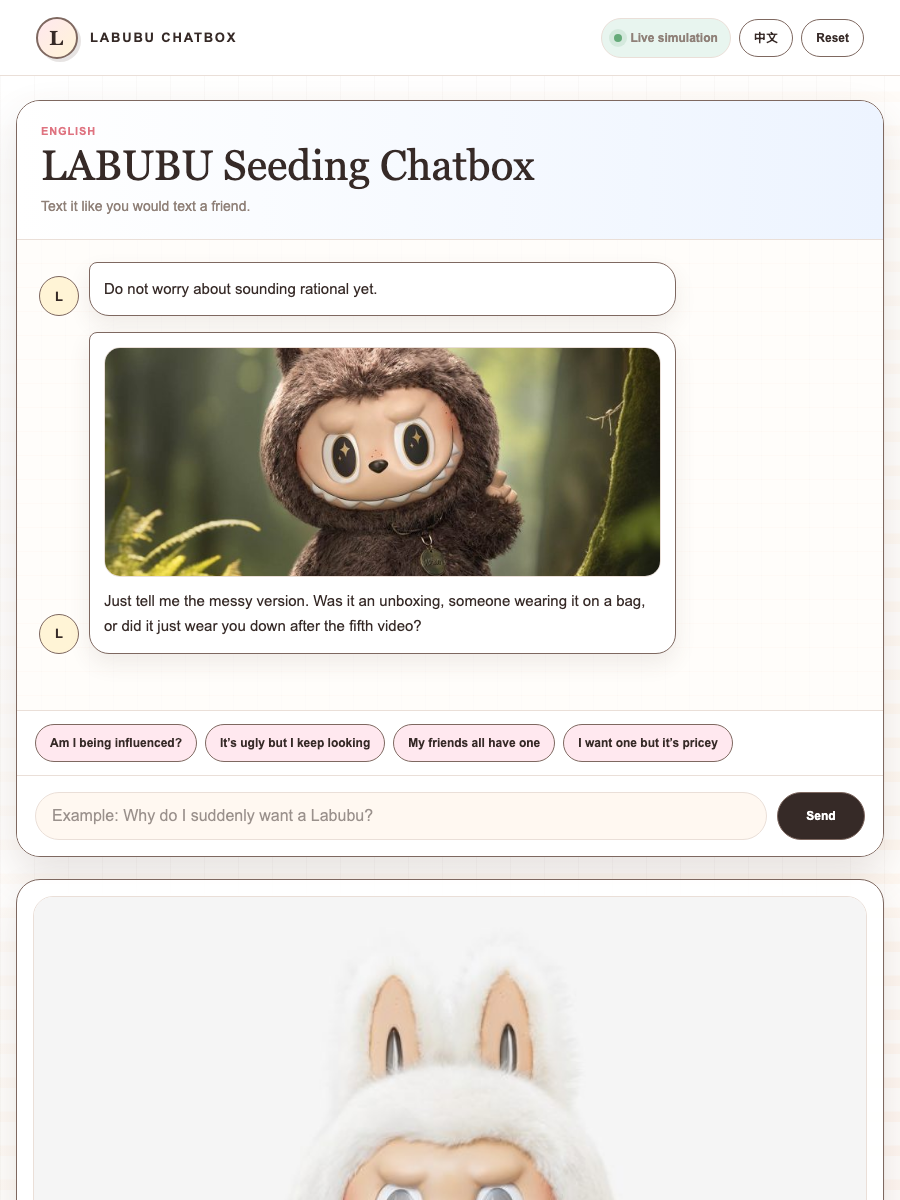
As digital culture continues evolving, emotionally driven and community-based consumption will likely play an increasingly important role in shaping future consumer behavior.
Reference
Akbari, M., Seydavi, M., Palmieri, S., Mansueto, G., Caselli, G., & Spada, M. M. (2021). Fear of missing out (FoMO) and internet use: A comprehensive systematic review and meta-analysis. Journal of Behavioral Addictions, 10(4), 879-900.
Athwal, N., Wells, V. K., Carrigan, M., & Henninger, C. E. (2019). Sustainable luxury marketing: A synthesis and research agenda. International Journal of Management Reviews, 21(4), 405-426.
Creevey, D., Coughlan, J., & O'Connor, C. (2022). Social media and luxury: A systematic literature review. International Journal of Management Reviews, 24(1), 99-129.
Davenport, T. H., & Beck, J. C. (2001). The attention economy. Ubiquity, 2001(May), 1-es.
Dwivedi, Y. K., Kapoor, K. K., & Chen, H. (2015). Social media marketing and advertising. The Marketing Review, 15(3), 289-309.
Franck, G. (2019). The economy of attention. Journal of sociology, 55(1), 8-19.
Godey, B., Manthiou, A., Pederzoli, D., Rokka, J., Aiello, G., Donvito, R., & Singh, R. (2016). Social media marketing efforts of luxury brands: Influence on brand equity and consumer behavior. Journal of business research, 69(12), 5833-5841.
Hennigs, N., Wiedmann, K. P., Klarmann, C., Strehlau, S., Godey, B., Pederzoli, D., ... & Oh, H. (2012). What is the value of luxury? A cross‐cultural consumer perspective. Psychology & Marketing, 29(12), 1018-1034.
Marwick, A. E. (2015). Instafame: Luxury selfies in the attention economy. Public culture, 27(1), 137-160.
Tufekci, Z. (2013). “Not this one” social movements, the attention economy, and microcelebrity networked activism. American behavioral scientist, 57(7), 848-870.
Verhallen, T. M. (1982). Scarcity and consumer choice behavior. Journal of Economic Psychology, 2(4), 299-322.
Zhang, Z. (2021, July). Research on blind box and its marketing strategy. In 2021 International conference on economic development and business culture (ICEDBC 2021) (pp. 115-118). Atlantis Press.